Showing posts with label best practices. Show all posts

Wednesday, July 18, 2012

You There – You Don’t Know Everything

I’m not telling you this to hurt your feelings. I’m telling you because knowing that you know nothing – to paraphrase Socrates – is the only true wisdom. 


When you recognize the unknown, you ask questions. And asking questions illuminates answers. 


For example, ever heard of the Five Whys? It’s a technique originated by Toyota in which you get to the root of a problem by asking "why" five times. Watch a good Five Whys primer from Harvard Business Review below.

But asking questions isn’t just good problem-solving policy. It’s essential to all leadership, creativity and innovation.

The key is to continuously break free from the biases and assumptions that hold back fresh ideas. After all, you know what happens when you assume, right? (It’s the mother of all mistakes.)

That’s why, in B2B marketing just like anywhere else, it always pays to start by challenging your assumptions and asking questions, whether you’re:
  •  Launching a product
  • Considering a brand extension
  • Starting an ad campaign
  • Entering a new market
  • Going after new customers

What’s the main objective and why? What’s the primary audience? What do they care about? How does what you’re offering make life better for them? And how do those answers fit into a single, clear message for the marketplace?

Those are just some of the questions bouncing around our office as we challenge our inner-know-it-alls and uncover new perspectives.

And now a question for you: What questions do you find helpful in your process?

Tuesday, February 14, 2012

7 Essential Attributes of Successful Email Campaigns


Online services like MailChimp and Campaign Monitor can make creating and distributing email campaigns easier and more efficient.

But beware: There’s more to successful email marketing than plugging your data into a form on one of these sites.

Email best practices continue to evolve on many fronts. Staying ahead of the changes can mean the difference between a campaign that captures your audience’s attention and one that’s captured by spam filters.

Here are some of the key areas to keep in mind:

Design that pops. Many online templates leave a lot to be desired, but good designers can help customize your look to make it more attractive and reflective of your brand.

Content that audiences care about. It pays to take the time to identify your audiences . Segment them in a way that makes sense for your company – whether that’s demographically, geographically or by products/services used.  Then you can address their needs, wants and pain points in a way that piques interest without giving away too much intellectual property. 

Spam filter friendliness. The restrictions imposed by filter programs are a moving target, with a growing array of red-flag phrases and practices – pay particular attention to subject lines – that will doom your distribution.

An accurate contact list. It’s crucial that you have correct info for people you’d like to reach as well as those who don’t want to be reached. Contacting only people who know you and who’ve opted in via web forms or in person will help keep you in their good graces – and off spam lists.

Optimization for relevant mail clients. Whether it’s mobile or desktop/browser software, you’ve got to make sure your email can be accessed easily and creates a consistent brand experience.

Review and adaptation. Heed your results and learn from them. What types of articles do audiences click on the most? Use the knowledge to adjust your approach.

A holistic approach.  Email marketing is only one piece of the puzzle.  An effective campaign needs to be supported by other online and offline activities that deliver a consistent message and provide valuable information. Consider social media channels, content marketing and public relations.


Tuesday, January 24, 2012

Case Study: 5 Things to Learn from Milacron’s Talent Acquisition Campaign


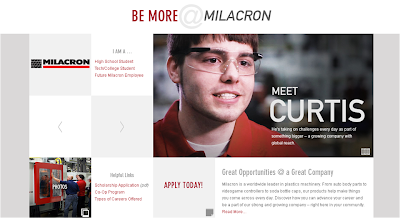
The statistics are in, and they’re good. After only six days live, Milacron’s new recruitment website has had 883 unique visitors, more than 4,011 page views and 260 people who filled out forms requesting employment opportunities.

Like many manufacturers, Milacron, a worldwide leader in plastics machinery, was experiencing a workforce shortage and needed help in attracting talent. The initial success of their new microsite is both a testament to the ability of a well-designed website to attract prospective employees and to the fact that there are people looking for manufacturing jobs.

In November, we wrote about 5 ways that manufacturers can address their workforce shortage. We have since been working with Milacron and other clients to put these ideas in actions.

Here are 5 key takeaways from the Milacron Talent Acquisition campaign:

1. Integrate the program: The initial launch of the microsite would not have been as successful had it not been surrounded by a strategic, multi-faceted program. The campaign encompasses social media presence including Facebook and Twitter, as well as public relations securing both local and trade publication coverage. The company is also fostering relationships with local technical and vocational schools, offering both a co-op program and a scholarship program and promoting Milacron as a good choice for job shadowing, apprenticeship and eventually permanent employment.

2. Base the execution in research:
Before designing and executing the campaign, interviews were conducted with current employees at Milacron to understand what was important to the young people in the organization – what they valued about working at Milacron. These interviews were coupled with background research into Millennials to better understand what this generation responds to and cares about. The research informed the employment brand and position as well as the development of the microsite and the surrounding marketing program.

3. Include video:
Video is a medium increasingly preferred to receive online information and is especially important for reaching younger people. We conducted onsite video and photo shoots featuring young people inside the organization. These videos will continue to be used throughout recruitment efforts.

4. Create an employment brand:
Leveraging the research, we developed an employment brand centered on showing prospective employees how they can “Be More at Milacron.” The messaging is woven throughout the microsite and video testimonials and will continue to serve as a foundation to speak to current and prospective employees, students, parents, educators and the marketplace.

5. Build an appealing careers section: The careers sections of many manufacturers’ websites leave a lot to be desired. The section needs to be informative and engaging, helping to familiarize students, teachers, parents and other non-industry individuals with a basic understanding of manufacturing in a way that highlights the long-term, technologically advanced and personally fulfilling career benefits the field can offer. A good careers section should be user friendly with intuitive navigation and be visually appealing to audiences, especially young people.

Thursday, November 17, 2011

3 Keys to Creating a Great Online Newsroom

As promised, here is a follow-up to last month’s post on 3 Reasons Why Your Website Needs a Newsroom. Building on the basics of what a newsroom is, what it isn’t and what it can accomplish, let’s look at three best practices of successful online newsrooms and a client example.


1. Keep it simple: Facilitate easy browsing and discovery.

Make sure the newsroom is easy to find and can be accessed from any page on your website, and vice versa. Done correctly, a newsroom will be one of the most visited pages on your site. Get more out of that traffic and enhance the user experience by linking visitors to other sections of the site. The user experience is more than just site navigation – it also involves strategically planning content. Think like your audience: What are they most interested in? Where will they look first, second?

2. Add more substance: Content equals more than just words.

Use digital media such as videos, images and graphics. Use original photography or develop simple graphics to add visual stimulation and excitement. But, be conscientious about balancing your message and using complicated images or technologies. Many users will view your site on mobile devices and tablets, so don’t be too flashy (literally, don’t use too much Flash video) and make sure all essential elements are easily viewable on different devices.

3. Let them see the real you: Showcase your personality with social feeds and other information.


If you maintain social media channels, bring your newsroom into the mix, housing feeds from Facebook, Twitter, YouTube and other networks. These not only provide strong calls-to-action to engage with your company, but they often show more of your company’s personality. Link to related research, educational materials and industry articles, as well as tradeshows you’re attending, events you’re speaking at, awards you’re receiving, etc. If someone wants to start a conversation, let them know what you’re up to.

In general, keep in mind that newsroom visitors are your potential or current customers, employees or media contacts. Make sure they know something more about your company after stopping by.

Thursday, November 3, 2011

State of Emergency: Manufacturing’s Workforce Problem

In a recent national survey of manufacturers administered by Deloitte and The Manufacturing Institute, 67% of respondents said they face a shortage of qualified workers.

As a result, many manufacturers can’t keep up with demand. It’s hardly the first time we’ve stressed the manufacturing worker shortage on this blog. But it’s worth revisiting today because the problem is increasingly urgent. How can we reinvigorate our stagnant national economy if one of its most significant drivers, cannot grow?

As a country, we must increase the supply of manufacturing workers with technical skills and education. But the relevant training programs are no longer as popular as they were for the baby boomers, a generation that was more fully supported in their pursuit of manufacturing careers.

Although the federal government is trying to address the manufacturing skills gap through various workforce development initiatives, manufacturers and their communities must also begin closing the gap on their own.

5 Ideas Manufacturers Can Implement Today

Create an employment brand. Just as you need the right messaging to attract the right customer, you need a strong employment brand to attract strong employment candidates. Ensure that your company’s values and culture are represented in this brand.

Refresh your careers section. Make sure you’re appealing to a younger generation. Include testimonials and biographies of current employees so young people can relate. Make your employment brand prevalent.

Use social networks. Reach young people where they hang out. Create a Facebook page and a YouTube channel and populate with videos. Showcase your facility, employees and what a day in the life looks like. Remember, most people never have been inside a manufacturing facility but have nevertheless formed negative opinions. Prove them wrong.

Start mentoring and onboarding programs. Engage and guide professional development and ongoing training. Implement a regular performance appraisal and feedback process. Maintain open and transparent communication between employees and management.

Form partnerships. Reach out to local vocational and technical educational facilities and organizations dedicated to workforce development. Work with them to design programs that include facility tours, open houses, speaking opportunities, student internships and teacher externships, apprentice programs, scholarship opportunities, etc. Get creative!

These are just a few examples of the many opportunities to attract and retain an engaged and productive workforce. What are some other ideas or programs have you seen implemented?

Tuesday, September 13, 2011

3 Reasons Why Your Website Needs a Newsroom


Years ago, maybe your company could have managed without an online newsroom – a home base for releases, media coverage, byline articles, event information, team biographies, fact sheets, media contacts, images, logos, etc.

But in the information age, it pays to make as much information as possible available and easy to find.

Here are the top 3 reasons an online newsroom is a smart investment and a crucial component of a successful marketing communications strategy.

Reason #1: Real-time reporting and shrinking staff.

At a time when overburdened media members are facing tighter deadlines than ever, if you don’t make information easily and quickly accessible, guess where reporters, editors or even potential customers are going to go for the information they seek?

A well-developed and populated newsroom turns browsing media into interested publishers who are more likely to tell your story than that of your competitors.

Reason #2: Digital distribution and re-purposing of content.

Remember that release that you wrote, that earned you an interview, which you videotaped and then edited, that you put on your YouTube channel and then announced on multiple social networks?

Well, where is all of that content now? What return is it earning you if no one can find it? All of that owned content should live right there on your newsroom.

• Integrated into social media feeds
• Linked to your blog
• Archived in your releases

Reason #3: Search engines love them.

Search engine spiders are out there crawling for fresh, valuable content. And that’s just what an online newsroom gives them. Quality content built around industry keywords is your ticket to a major traffic spike.

A newsroom also can increase your online real estate – meaning you have more unique pages for search engines to index, increasing the likelihood you’ll be found in search queries.

In a future post, we’ll look at the key components of a successful online newsroom. In the meantime, here’s a pretty good example to shoot for: InsideSH News..

Friday, October 30, 2009

New CNN Site Did Your Web Design Homework

CNN.com, the country’s highest-traffic network news site, went live this week with a redesign that’s worth further study.

Not sure if it’s as “beautiful” and “visually arresting” as the CNN folks claim, but it definitely has a greater emphasis on images, video and easily digestible, modular content. Adweek says there’s a lot more interactive, social functionality, as well.

The redesign reflects an important step in CNN’s transition—from just an online iteration of a TV network, toward a distinct news site that takes advantage of the web’s unique capabilities. But good as the new site is, it isn’t by any stretch revolutionary. CNN’s really just following the lead of non-mainstream news sites such as The Daily Beast and Newser.

The difference? CNN is a big organization backed by an even larger corporate parent, Time Warner. The changes they’ve made are almost certainly driven and justified by thorough research. They’ve looked carefully at what the audience wants: a more custom user experience and greater involvement with the content. These results appear to validate the savvy design and social aspects of those alternative news sites.

That’s why it’s a good idea for all of us to pay attention. The new CNN shows that social functionality, quick-read convenience and interactive communication are now mainstream must-haves on the web.

OK, so your site won’t make Alexa’s top 500 anytime soon, but you can still benefit by deploying some of the best practices of those that do.

Friday, October 2, 2009

An Old-School Social Media Success

Using social media can help you achieve lots of big goals—gaining recognition as a thought leader, generating leads, pumping up sales, etc.

But just as often, success in social media is simply about finding more efficient, effective ways to solve problems and increase customer satisfaction.

Take this Pitney Bowes example we just read about.

The postage meter people decided that maybe they were spending too much time and money on customer support phone calls. So they created an online user forum where customers could pose and answer each other’s questions, moderated by the company.

With the help of customers’ diverse content input—kind of a crowdsourced FAQ—Pitney Bowes’ forum quickly delivered robust answers to many of the most common questions that people used to call the hotline for. In the process, they’re saving the company money and customers lots of stressful time on the phone.

And maybe the most important (and reassuring) lesson here is that they did it without using the latest and greatest platforms. No Twitter, no Facebook, no StumbleUpon—just a clear objective and good ol’ forum, with great results.

Wednesday, August 26, 2009

Another One of Those Incremental Improvements That Keep Google Ahead

Here’s something that shouldn’t surprise you: Google just keeps getting smarter.

Last week, the Internet frontrunner announced changes that will enhance its contextual targeting capabilities.

Contextual ads show up on pages of Google publishing partners. These AdSense ads are supposed to be relevant to various keywords on a given page. (Say you load a story about increasing new home construction. You’re likely to see an ad from a homebuilder.) When it works, it’s your typical, intuitive, don’t-even-realize-it’s-happening Google experience.

Trouble is, sometimes Google’s contextual targeting hasn’t worked quite right. Like when an ad for cheap airline tickets shows up on a page about a plane crash. Here’s an amusing slideshow of some of the most egregious examples of contextual targeting mishaps.

The changes Google announced this week should cut down on these embarrassing exceptions—once again keeping Google ahead of the pack in terms of creating an ever smoother, more customized Internet that works better for advertisers and users alike.

That’s not only good news for you if you’re an advertiser. It’s also a good example. The lesson? Never stop improving. The folks at Google never do, and that’s one of the ways they maintain a competitive edge.

Tuesday, January 13, 2009

Marketing Efforts Must Begin with Accountability

Advertising Age’s Michael Fassnacht has a great column titled “Producing Accountability in Hard Times.”

In these days in which even U.S. Senators are clamoring for accountability for TARP Funds, Michael’s message should be heeded by anyone involved with marketing and sales communication expenditures.


My strong beliefs about being accountable for results shouldn’t be that surprising to readers of this blog. See, for instance, this post on the ROI/accountability conversation from 2006.

Friday, October 24, 2008

Confidence, Compassion and Composure

Why ‘Emotional Intelligence’ Matters More Than Ever

So, how’s morale?

The recent economic turmoil has frayed even the steeliest nerves. And if the ups and downs are haunting you—be honest, now—then they’re probably spooking everyone else in and around your organization.

There’s no better time for a check on your “emotional IQ.” The term, which refers to a person’s ability to identify and manage the emotions of themselves and others, was the timely topic of a program put on last week by Tempo Milwaukee. A panel of executives from a variety of companies explored the most “emotionally intelligent” communications approaches for leaders during the current economic crisis.

What’s your company doing to weather the storm? What new pressures does this put on the team to perform? These are the kinds of questions on the minds of employees and customers alike. Company leaders can rise to this communications challenge by deploying emotional intelligence in understanding, acknowledging and addressing these concerns.

It’s about more than just telling people things will be OK. After all, empty reassurances and blind cheerleading won’t overcome the worries. And left unchecked, low-key fretting can turn to full-scale panic, which can wind up dictating the (wrong) direction of your company.

Leaders must be in tune with these cultural mood swings. And they must address them without reflexive emotional responses. Verbal diatribes, email flame wars and the like only escalate the negativity.

Instead, you’ve got to step back, take a deep breath and then confront the issues head on in a thoughtful manner. Project confidence, compassion and composure, and do it continuously—in all employee communications, customer newsletters, press interviews, etc.

Such emotionally intelligent leadership can help keep companies strong for when the outlook inevitably turns brighter in the months ahead.

Tuesday, October 7, 2008

Expanding Your Reach through Strategic Alliances

Is it better to have actual facilities in far-flung places, or just friends there?

For many companies, there’s no debate. Owning bricks and mortar in foreign lands just isn’t feasible. That’s probably never been truer than in this tenuous economy and tight credit market. Nevertheless, for more and more businesses, having a global presence is still essential.

The good news is that there’s a way to expand your reach without taking huge risks in terms of capital and credit: through well-crafted strategic alliances. That’s what many of our international clients have done. And it’s what we’re doing, too.

Last week, I attended the annual conference (in Boston, Mass.) of IPREX, one of the world’s largest networks of independent public relations agencies. IPREX puts us in a valuable partnership with reliable, accountable PR teams on the ground all over the world. So we have immediate access to cultural knowledge and communications expertise—whenever and wherever our international clients are doing business.

We not only support each other’s communications programs. We stretch our thinking, we provide each other access to both geographic and market-specific competencies, and we share best practices with a diverse group of professionals. It’s a far cry from the “not invented here” mentality or partisan politics that too often put individual success and the greater good at odds.

So perhaps it’s time to think differently about your competitors. Beneath the surface, you might just find a strategic ally and a company whose market and niche expertise may actually complement yours.

In an increasingly sophisticated, volatile and interconnected global marketplace, you might say that’s the best of one world.

Friday, September 12, 2008

Walking the Talk of Brand Evolution

We talked a couple of weeks ago about the importance of evolving your brand. But if it ain’t broke, why fix it?

Well, it’s like home maintenance. Better to reinforce the roof before it caves in. Or think of it like a romance: You’ve got to keep it fresh.

Never get too comfortable with your brand, because the marketplace in which your brand lives is always changing—and besides, there’s always room for improvement. We aren’t just saying that. Right now, we’re launching a new Scheibel Halaska website, with an updated, refocused brand message.

We took some time to look deeper into what our clients care about and what we do that accelerates their success. That gave rise to a new tagline and a complete redesign of InsideSH.com.

The new site was a long time coming … but it won’t be long before you see more changes. That’s because we’re determined to keep our public face lively and up to date, just as we’re working every day to keep our services relevant and valuable to our clients. After all, it’s what we tell our clients (and blog readers) to do all the time.

Friday, September 5, 2008

McCain vs. Obama: 3 Lessons in Online Marketing

It’s shaping up to be a fascinating home stretch in this U.S. presidential election cycle. More interesting to us as BtoB marketers, however, is how the candidates are using online technology to share their message.

Some obvious contrasts:

Barack Obama’s campaign has long been recognized for taking advantage of web 2.0 interactive capabilities, including customizable my.barackobama.com home pages for supporters. That’s two-way communication, a conversation with the audience.

John McCain’s approach has been more traditional, using the web as a broadcast medium and airing the latest campaign commercial on the home page. That’s one-way communication, talking to the audience.

But the biggest difference is probably that Obama appears to have a more comprehensive, integrated online strategy. For example, the initial announcement of his VP running mate pick via text message.

These are generalizations, and the McCain team has been catching up in many ways. That’s what’s so great about online: you can keep improving as you go along.

So, without further ado, three lessons for marketers from observing the candidates online:

Exploit interactivity. The web is ideal for reaching more targets than ever—and understanding what they’re thinking. So seek every opportunity to engage your audiences. Calls to action, polls, comments threads are perfect ways to start the conversation.

Pursue an integrated strategy. The most advanced, innovative uses of online technologies aren’t worth much if they aren’t means to an end.

Continuously improve. Your website, like the technologies that support it, can and should constantly evolve. Shouldn’t be a problem, because the marketplace is always changing, so you should already be in a continuous improvement frame of mind. Simply extend this mindset to the web.

Friday, July 18, 2008

Facebook as a Reference Check? Be Wary.

Social media are increasingly on companies’ radar screens, and rightfully so. Opportunities abound to connect with customers and understand what’s on their minds. You should be exploring the possibilities.

But what about this trend toward visiting social networking sites in reference checks?

On the surface, it might seem to be a good idea. Cultural fit is a critical factor in the success of a new hire, and a Facebook page may shed some light on whether someone would be compatible. Or so the thinking goes.

However, do the personal details, opinions, pictures and jovial nonsense you might find online about a job candidate really represent who that person is—let alone have any bearing on his or her job qualifications?

Say you’re considering hiring a recent college graduate, the kind of recruit you’ll need to replace retiring baby boomers. Then you find some drinking-party photos posted by the candidate. Pretty typical stuff for the demographic. Nevertheless, based on the photos, you decide that person isn’t company material.

You may have just discounted a talented, reliable worker. And you may also have put your company at risk of privacy and discrimination claims.

OK, maybe not privacy. It’s called social networking, after all. However, if there’s any way it might appear that you eliminated the candidate based on the way he or she looked (i.e., skin color) or what he or she believes as you learned online, then you’re on shaky legal ground.

Given the rising impact of online social networks, you’ll be reading a lot more in this space about social media issues and approaches. For now, however, with respect to reference checks on social networking sites: proceed with caution.

Wednesday, July 2, 2008

Multitasking: The Enemy of Ideas

Why are you reading this? Couldn’t or shouldn’t you be doing something else?

If you’re like many of us, you may already be doing something else right now, in addition to reading this post. Responding to emails, perusing networking sites, firing off a text message, twittering, talking fast on your mobile.

A good column in the current BtoB Online calls attention to this issue. We euphemistically call it multitasking, but it’s often more like “going through the motions.” All this connectivity is putting us into a weird trance.

It’s not only unproductive; it’s uncreative. For anyone in the business of ideas—and aren’t we all?—this is something to be concerned about. Think of the old saying, “a jack of all trades and a master of none.” Try to do too much at once, and you end up doing nothing of value.

Communications technologies tempt and distract at every turn. But they aren’t going away. Although it’s odd for a blogger to tell readers to tune out the Internet for a while, it’s still good advice. (Next week, we’ll explore how that might even raise your IQ and reading comprehension skills.)

When was the last time at the office that you shut your door—if you have one—and, more importantly, shut down your computer and various handheld tech gadgets for any length of time? These days, to get creative, to really get into it, we probably have to put it on the calendar and set a reminder. Commit to an hour or two per week, maybe, to start.

Go ahead. Just for a few minutes. Put down the mouse, back away slowly, and let the ideas flow.

Thursday, June 26, 2008

Factory shooting underscores importance of solid crisis communications planning

Yesterday’s tragic shooting spree at the Atlantis Plastics plant in Henderson, Ky., serves as an unfortunate reminder that disaster can strike at any time.

Fires, explosions, natural disasters, chemical spills, manufacturing accidents, labor strikes—every crisis threatens a company’s stability, its reputation and, in the worst case, its survivability.

That’s why, when a crisis occurs, your response must be swift and effective. And the secret to taking quick control of a crisis? A sound crisis communications plan. It’s a strategic roadmap to get you through a situation, while minimizing potential damage.

Here’s a primer for developing your plan.

Getting started

  • Set your crisis management team. Include the CEO, department managers, public relations team members, legal representatives, security and human resources personnel.

  • Outline your protocol. Work with your internal or external communications team. Get the necessary resources aligned. Work through the possible contingencies and conduct a crisis audit.

  • Determine your communications process. Identify your audiences and how you’ll communicate with them—face-to-face, telephone, e-mail, etc. Prompt, proactive communication is essential.

  • Anticipate common questions. Prepare responses that can then be modified based on the nature of the crisis.


  • In the moment of crisis

  • Never provide a "no comment" response. Such evasion is often interpreted as though you have something to hide.

  • If you’re still gathering information, say so. Share what you know and pledge to provide additional information as soon as possible. You’ll show that you’re actively working to stabilize the situation.

  • Never lie or speculate. Stick to the facts that you can speak to with certainty.

  • Exude calm. Your demeanor can directly affect public perception of the situation and your company overall.


  • And here’s the best tip we can give you, by far: If you don’t already have a crisis management plan, start developing it right now.

    Tuesday, May 13, 2008

    Ramp up Your Customer Retention Efforts

    Is customer service dead? You’d better hope not.

    Customer service is, of course, the key to satisfied customers. Scratch that—not just satisfied, but loyal customers.

    Even in bullish economic times, customer retention costs a lot less than customer acquisition. And in the current iffy economy, retention is even more important.

    But many B2B marketers remain more focused on attracting new customers, according to a new report.

    The Chief Marketing Officer Council’s study, highlighted in BtoB Magazine, found that only one-third of global marketers have strategies in place to win back dormant or lost customers, and only half have strategies to further profit from key account relationships.

    That’s too bad, because a host of new media and technologies offer us all kinds of fresh opportunities to understand, inform and interact with customers. For example, Scheibel Halaska works with several clients on email newsletters aimed at keeping customers in the loop.

    Current customers, after all, are your most crucial target audience. Sure, you’ve got to be out there selling. But it’s a whole lot easier to sell to the folks who are already sold on your company.

    Monday, April 14, 2008

    Who Cares What the Competition’s Doing?

    You shouldn’t—or not much, anyway.

    Last week, we touched on business strategies and hedgehogs and such. To follow up, here’s a column from BtoB magazine that’s a window on the strategies of leading companies.

    Author Wes Ball gives us a snapshot of what his firm’s research uncovered about “alpha companies,” as he calls them.

    Here’s the big idea:
    Nonalpha thinking: Focus on staying ahead of competition.

    Alpha thinking: Focus on what your b-to-b customers want to buy.
    Of course, it’s important to keep an eye on what other companies in your market are doing and saying—but maybe only to make sure you aren’t doing and saying the same things.

    After all, what’s good for another company isn’t necessarily good for yours. Instead, what’s best for your company is whatever you do best—and that customers value.

    In the B2B game, your customers’ success drives your success. So we counsel our clients to pursue a customer-centered strategy, and make that the foundation of everything they communicate.

    In other words, move the way alpha companies do. They don’t get mired in keeping up with the competition; they’re too busy focusing on their customers’ needs. So take a page from their playbook: Stay out of the “me, too” fray, and you’ll stay ahead of the competition.

    Monday, September 24, 2007

    Building a Name in Blogging—without Your Own Blog

    Having a web presence is critical. And lately, more and more companies are even taking the time to create their own corporate blogs. But starting and maintaining a successful blog is a substantial undertaking requiring a lot of time and commitment. A blog must feature engaging posts on compelling topics—consistently.

    If your organization doesn’t have the resources to do justice to your own blog, there’s another way to build an online presence: contributing to other blogs. In Milwaukee, we have BizBlog, a blog updated daily as part of the The Small Business Times. Check out how John Scheibel, our CEO, is increasing Scheibel Halaska’s presence on the web.