Showing posts with label public relations. Show all posts

Monday, June 17, 2013

Act Globally. Think Locally.

I recently returned from a two-week trip to Shanghai for the annual meeting of IPREX, a global network of communications agencies. 

It was my latest in a string of opportunities to travel overseas in recent years, on account of taking on an increasing role in IPREX (I was sworn in as the new president at the meeting), as well as serving several clients with global operations.

But throughout my relatively modest travels, I’m always reminded of an important truth upon my return: I still have a lot to learn about the people and places I’ve visited. 

So who can help me better understand these essential elements? Only the people who’ve lived there all their lives. 

If you’re looking to succeed on international fronts, there’s simply no substitute for local expertise. You need people who not only speak the language fluently, but also truly understand the culture, the mindset and the current environment.

That’s why our partners throughout IPREX are so important to our business and our clients. In a global economy in which knowledge and speed are crucial, these relationships ensure instant access to professionals who really know how to advance success in Shanghai, Sao Paulo, Sydney and so many places in between.

Thursday, May 16, 2013

Honing the Elevator Pitch for Analyst Presentations, Media Interviews and More

Guest post from Tom Gable, founder and CEO of San Diego IPREX partner firm, Gable PR

Whether working with a CEO who loves to spin long tales about his company and his successes, a Ph.D/M.D. who knows too much, or a startup or anyone else who is new to trying to connect with financial, media and other audiences, we’ve found a good starting point in the communications process is drafting a classic elevator pitch.

The challenge is writing short copy, especially for engineers and scientists who are used to citing published articles, case histories and other resources ad infinitum. The long approach is perfect for pitching peers and colleagues, less so for connecting with analysts, the media and non-industry audiences. Thus, the following was created by Gable PR as a starting point for honing a one to two minute pitch (also referred to as the cocktail party pitch) to grab the attention of your audience in the shortest amount of time and set the stage for next steps.

TAG LINE/SOUND BITE – The opener – an instant picture or quick summation of your positioning.  What you do, what you stand for, to what effect and why it’s important. One sentence is best. Practice with people who don’t know what you do and keep honing this one sentence (two at the most) until it rings like Shakespeare.

PROBLEM, SITUATION ANALYSIS – What exists – the pain or problem you solve?

DYNAMICS AND OPPORTUNITY – Quick historical overview of how it got to this point, how the challenge has been addressed, what is the sweet spot for your company or organization (keep it to three important points, no more!).

WHAT (solving the problem) – Your company (or organization) has been working X years to plan for and develop D, E and F to solve the problem, take advantage of the market opportunity and grow and succeed over the next Y years.

OVERVIEW FROM 30,000 FEET – We have done it: the macro view, the big picture of how your great concept all comes together and grows market share, sales, traffic, profits, benefits the community, whatever – the BIG PICTURE vision of future success rather than technical details and features.

SO WHAT (benefits) – You will succeed because of the creative planning, results and ultimate value you deliver.  Create a mental picture of the benefits to science, patients, customers, the world. If there is a good case history, cite the proof of principle in a sentence or two. Do it in two sentences and you get a Pulitzer Prize (plus the desired result).

THE TEAM – The team includes executives with national credentials in A, B and C. It has a combined ZZ years in the industry, has built MM, helped YY other companies or institutions grow and knows the market and how to provide an expanding array of products and services to help it succeed (make it relevant to the big picture).

THE CLOSE (call to action on the elevator) – “We have the people, the plan and the commitment to succeed in a rapidly growing new market.  I can provide incredible detail that I believe will convince you to … (invest, interview, buy, etc.).  How about a follow up meeting?  Where would you like to meet?  What else can I provide?”

Ask questions that will take it to the next step!

Monday, May 6, 2013

Corporate Social Responsibility Isn’t Just Good PR

It’s also a recruiting tool. A path of professional development. And a whole lot more.
For example, I serve as the PR + Media Chair for Autism Speaks Milwaukee. We’re just coming off some big events in April for National Autism Awareness Month, most notably the fifth annual Walk Now for Autism Speaks in partnership with the Milwaukee Bucks at the BMO Harris Bradley Center. 
Together, our committee of 10 young professionals gained the support of numerous corporate sponsors, participation of 25+ area businesses that support the autism community, secured media sponsors and coverage in our local market and produced awareness pieces with one of the Bucks’ most notable players – Brandon Jennings.
Events like these require a fair amount of time and energy. But I’m happy to do it, because it’s a cause that’s close to my heart. And I’m just as happy that our agency encourages me to support it. I believe many young professionals like me are looking for opportunities to give back to the community, and we gravitate toward employers that boost these efforts.
Many of my coworkers also donate time and talents to individual causes, and we participate as a team in corporate fundraising campaigns for organizations including the United Performing Arts Fund, as well.
In the process, we’re improving the communities in which we live, work and play – while also improving individual skill sets by taking on additional professional responsibilities outside the office. I see that as a win-win-win for me, my community and my employer.
What about your organization? What do you do to advance CSR?
By the way, look for these upcoming Autism Speaks events: Team Up! with Autism Speaks during the Summerfest Rock ‘n Sole Run on June 13 and Ride for Autism Speaks at the House of Harley on July 15.

Tuesday, April 17, 2012

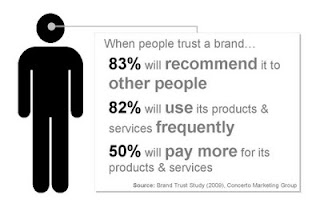
How Tapping into Emotions Plays a Larger Role in Building Brand Trust

The science of selling is changing. With the growth of social media, tapping into emotions has become an increasingly influential part of decision making. Although statistical data hasn’t gone to the wayside, consumers look to fellow purchasers for their opinions of, or experiences with, businesses, as well as goods and services. It’s these experiences and interactions that form people’s opinions and in turn, influence brand trust.

During a Southeastern Wisconsin PRSA luncheon, Eric Goering, manager of global system communications for McDonald’s, discussed the idea of brand trust, commenting, “No one wants to feel like a guinea pig. Consumers want to know that a product or service is already safe and effective.” Referencing McDonald’s new “field to fork” commercials, he continued by suggesting that the value proposition now takes a different form – facts mean less and emotions mean more.


In addition to McDonald’s new commercials, Chipotle has leveraged its new sustainable farming campaign to make that emotional connection with consumers. The commercial has been largely popular among audiences because of its honest, authentic message, which plays into consumers’ demands – products that are fresh, locally grown and nutritious, while also helping to boost the nation’s agriculture industry.


Today, the story is becoming more about these relationships, which highlight a company’s commitment to quality and consistency that drive customer decisions. In turn, those decisions are now broadcast across social networks, earning businesses positive word-of-mouth marketing that ultimately increases sales and new opportunities overtime. In the same vein, this idea should resonate with B2B companies, as true partnerships, not just one-off relationships, become critical to future success.

Have you seen good examples of companies tapping into customers’ emotions? If so, what made it compelling?

Monday, November 21, 2011

Entering the Marketing Communications Job Market? Ten Tasks to Tackle Today

Last month, I participated in a panel discussion of fellow UW-Oshkosh journalism alumni to provide students with advice on entering the “real world.” And while their questions were particularly helpful for soon-to-be grads, much of the advice also was beneficial for entry-level professionals.

Here are the top 10 pieces of advice from our panel:

  1. Keep building your skills. Gain experience in writing, design, web, social media, etc. Today, employers are really looking for a jack (or jill)-of-all-trades.
  2. Keep your résumé to one page. Take the short and sweet approach. Whether you’re fresh out of college or looking for your second adventure, be objective – only include experience that really demonstrates what you can do on the job.
  3. Illustrate your abilities in cover letters. Match your expertise to a company’s specific needs. If they’re looking for someone with web design experience, describe a successful project and add metrics of success.
  4. Create a portfolio and make it available online. While hard copies are nice, an online portfolio showcases your work in a format that’s easy to revisit, which is especially important with a limited amount of time during interviews.
  5. Secure internship experience. Whether you’re still in school or recently graduated, an internship can provide valuable work experience that allows you to expand your capabilities – or get your foot in the door at a specific company.
  6. Network. A lot. Stay in touch with fellow students, alumni and professors to remain in consideration for job openings. Attend professional development events or alumni networking opportunities, and use social media to maintain connections.
  7. Express your self-confidence. Hiring managers want to know that you won’t be afraid to offer ideas or contribute to team projects. Be bold and outgoing, and show your passion for the job.
  8. Maintain professionalism. Even though you may think you know what’s acceptable in a company’s culture, err on the side of caution and present yourself professionally. You’ll earn respect as you get to know the company’s personality better.
  9. Take initiative. Ask questions. If your supervisor gives you a challenging project, don’t be afraid to ask questions and take ownership. Be proactive and anticipate clients’ or supervisors’ needs.
  10. Drive your own growth. Don’t be afraid to ask for more responsibility. Ultimately, you’re the one in charge of your career, and if you don’t speak up, you may not get to where you want to go. In addition, don't be afraid to move on if you feel you can no longer grow professionally.

Want more? Check out this PR Daily article for additional insights: 5 tips for landing your first PR job after college. I’d also encourage readers to follow the #HAPPO and #PRStudChat conversations on Twitter, which offer regular advice, tips and suggestions for students and entry-level professionals.

If you’re in a hiring position, do you have other suggestions for young professionals, and if you’re a young pro, are there other questions you’d like us to address?

Thursday, November 17, 2011

3 Keys to Creating a Great Online Newsroom

As promised, here is a follow-up to last month’s post on 3 Reasons Why Your Website Needs a Newsroom. Building on the basics of what a newsroom is, what it isn’t and what it can accomplish, let’s look at three best practices of successful online newsrooms and a client example.


1. Keep it simple: Facilitate easy browsing and discovery.

Make sure the newsroom is easy to find and can be accessed from any page on your website, and vice versa. Done correctly, a newsroom will be one of the most visited pages on your site. Get more out of that traffic and enhance the user experience by linking visitors to other sections of the site. The user experience is more than just site navigation – it also involves strategically planning content. Think like your audience: What are they most interested in? Where will they look first, second?

2. Add more substance: Content equals more than just words.

Use digital media such as videos, images and graphics. Use original photography or develop simple graphics to add visual stimulation and excitement. But, be conscientious about balancing your message and using complicated images or technologies. Many users will view your site on mobile devices and tablets, so don’t be too flashy (literally, don’t use too much Flash video) and make sure all essential elements are easily viewable on different devices.

3. Let them see the real you: Showcase your personality with social feeds and other information.


If you maintain social media channels, bring your newsroom into the mix, housing feeds from Facebook, Twitter, YouTube and other networks. These not only provide strong calls-to-action to engage with your company, but they often show more of your company’s personality. Link to related research, educational materials and industry articles, as well as tradeshows you’re attending, events you’re speaking at, awards you’re receiving, etc. If someone wants to start a conversation, let them know what you’re up to.

In general, keep in mind that newsroom visitors are your potential or current customers, employees or media contacts. Make sure they know something more about your company after stopping by.

Wednesday, November 9, 2011

Utilizing Virtual Events to Reach a Larger Audience

Milacron Plastics Technologies, one of our plastics manufacturing clients, recently hosted an open house at its Ohio manufacturing facility for customers, media and industry personnel. The three-day event showcased a variety of technical demonstrations, expert presentations, product overviews, facility tours and other programs.

While aggressive promotion resulted in high turnout at the event, there were still many individuals who couldn’t attend.

Because the information and demonstrations presented at the open house provided significant value to those in the industry, Milacron didn’t want to limit its scope to only in-person attendees. The company decided to consolidate the content and make it available online in the form of a ‘virtual open house.’

Hosting a virtual event like Milacron’s open house can provide visitors with an interactive experience of the event, which can include:

  • Video demonstrations
  • Attendee and exhibitor interviews
  • Photo slideshows
  • Downloadable presentations and collateral
  • Links to media coverage of the original open house

Milacron launched its virtual open house through an email campaign to customers, prospects and media. PlasticsToday summed it up by saying: “…We don't need convincing that a virtual event can be just as instructive, and a lot more convenient, than traveling somewhere.”

Look for more open houses and other events to go ‘virtual’ in the near future. It’s a great way of leveraging technology to reach a broad audience. And, by hosting an in-person event and following it up with a virtual event, you may be able to get the best of both worlds.

Monday, October 24, 2011

5 Key Elements of Social Media Success

Each month, people spend the equivalent of 1.3 million years on Facebook. That’s a lot.

But it’s no wonder: we spend a lot of time on Facebook and other social media because we can do a lot – stay in touch with family and friends, stay up-to-date on news and, for many businesses, stay in front of customers and prospects.

For B2B marketers, however, there are still many questions about what to do with social media and how to do it. Fortunately, answering many of these questions – on best practices, strategies, etc. – was the mission of the recent PR + Social Media Summit (#PRSMS) I attended at Marquette University.

The all-day summit featured 15 sessions jam-packed with valuable information, but here are five of the most interesting takeaways:

1. Content remains key. You need to share valuable content with an honest, transparent voice in order to build an active community that fuels conversation and growth. Make it fun, honest, relevant and valuable. Look for stories that are happening within your organization – stories that your audience can’t find anywhere else – and tell them in a unique way.

2. Social = listening. As much as you need good content, you should still listen more than you talk, answer more than you promote, and above all else, provide value. Listen to answer this question: What does my audience need, and how can I help?

3. Not everything happens online. Develop offline elements to your social programs. Get your teams out in the field to interact with your audiences.

4. Think long term. The greatest value of social media is the ongoing relationship, not the initial interaction.

5. Represent the whole organization. To be effective, social media has to be integrated across all functions to effectively communicate your key messages and address customers’ questions or concerns instantly.

What ingredients do you think are necessary for a recipe of social media success? Ultimately, social media engagement is about proving your value, so audiences will share positive interactions with their networks, encouraging others to turn to you for similar business solutions.

For further reading, you can review some of the summit speakers’ presentations at http://www.slideshare.net/prsmsummit.


Monday, October 10, 2011

Selecting the Right Spokesperson for Your Organization

[HINT: It doesn’t have to be someone from the C-Suite]

Consider this: how long does it take you to form an opinion of someone?

(Three…two…one…)

OK – pencils down. What’s the answer? Just one-tenth of a second, according to Noeleen McGrath, award-winning journalist and founder of McGrath Communications.

That’s why it’s important to select the right spokesperson for your organization. With that in mind, the Southeastern Wisconsin PRSA chapter invited McGrath to present at its most recent luncheon on how to choose the right “face” or “voice” for a company.

So what should you look for in potential spokespeople to create that desired first impression? The decision should be based on three elements: message, audience and experience. What message do you want to communicate, to whom, and what experience is necessary to support that message?

While typical spokespeople tend to be CEOs or other C-level executives, they’re not always the right fit. After answering the questions above, the right spokesperson should meet the following criteria:

Appealing:

While it may sound shallow, the truth is that looks matter. By nature, people want to listen to attractive individuals. That said, it’s important to wear the right outfit on camera. After grabbing someone’s attention, you don’t want viewers to lose your message due to distractions (e.g., a lot of accessories are a no-no). McGrath suggested wearing bold, solid colors, which film well on screen.

Confident, trustworthy & knowledgeable:

You want someone who can stay cool, calm, collected and comfortable in front of the camera, which comes through with confidence and knowledge. As a spokesperson, it’s important to never get emotional or aggressive. Once you expose your emotions, you leave yourself vulnerable to providing poor responses to other questions.

Likeable:

Again, it’s important to remember that not everyone is fit for the job. Therefore, cast a wider net within your organization and find “average joes” who can relate to your specific audience. Establish trust by finding someone who can connect with them on a more personal level – do they have kids, live in the same community, or participate in similar activities?

It’s these three key traits that will gain – and maintain – your audience’s attention, helping to make the right first impression. Aside from these points, what else would you suggest when considering spokespeople?


Thursday, September 22, 2011

Don’t Just Earn Media. Earn Attention.

Back in the day, your target audiences’ main sources of information were dominated by traditional and trade media. It made sense to focus on gaining coverage, or “earned media,” in those outlets.

But in the increasingly interconnected world of social media, the middle man is disappearing. Your customers and prospects go to Twitter and Facebook for news, reviews, suggestions and promotions.

The good news is that you can connect directly with them in these realms. But that doesn’t mean they’ll pay attention – too many choices, too little time. That’s why building brands is no longer just about earned media, but about “earned attention.”

In “Why ‘Earned Attention’ is a Social Media Objective,” (subscription needed) author Deborah Budd highlights the need to tap into target audiences’ emotions, grabbing their attention and generating conversations. The key is to consider what you can contribute to your audiences – customers, partners, employees, industry members – via social media:
  • Share content and commentary about industry trends and best practices.
  • Highlight what your business offers in the context of these conversations.
  • Provide thoughtful updates, such as customer successes, that include a call to action.
  • Show your lighter side, which helps to strengthen connections and build loyalty.
In the process, you’ll build trust, demonstrate thought leadership, and position yourself as a valuable partner in an increasingly crowded marketplace. And the attention you earn will flourish, as your audiences become your advocates, disseminating your messages throughout their networks.

What do you think are challenges faced by B2B marketers seeking earned attention, and what advice would you have to achieve this important new objective?

Tuesday, September 13, 2011

3 Reasons Why Your Website Needs a Newsroom


Years ago, maybe your company could have managed without an online newsroom – a home base for releases, media coverage, byline articles, event information, team biographies, fact sheets, media contacts, images, logos, etc.

But in the information age, it pays to make as much information as possible available and easy to find.

Here are the top 3 reasons an online newsroom is a smart investment and a crucial component of a successful marketing communications strategy.

Reason #1: Real-time reporting and shrinking staff.

At a time when overburdened media members are facing tighter deadlines than ever, if you don’t make information easily and quickly accessible, guess where reporters, editors or even potential customers are going to go for the information they seek?

A well-developed and populated newsroom turns browsing media into interested publishers who are more likely to tell your story than that of your competitors.

Reason #2: Digital distribution and re-purposing of content.

Remember that release that you wrote, that earned you an interview, which you videotaped and then edited, that you put on your YouTube channel and then announced on multiple social networks?

Well, where is all of that content now? What return is it earning you if no one can find it? All of that owned content should live right there on your newsroom.

• Integrated into social media feeds
• Linked to your blog
• Archived in your releases

Reason #3: Search engines love them.

Search engine spiders are out there crawling for fresh, valuable content. And that’s just what an online newsroom gives them. Quality content built around industry keywords is your ticket to a major traffic spike.

A newsroom also can increase your online real estate – meaning you have more unique pages for search engines to index, increasing the likelihood you’ll be found in search queries.

In a future post, we’ll look at the key components of a successful online newsroom. In the meantime, here’s a pretty good example to shoot for: InsideSH News..

Friday, September 2, 2011

The Dos and Don’ts of Successful Blogger Relations

Like it or not, bloggers are a force to be reckoned with in your PR efforts. But these aren’t your father’s journalists; they must be approached in a different way.

With that in mind, the PRSA Southeastern Wisconsin chapter focused its August luncheon on “Blogger Relations for Dummies (and PR Pros).” Blogger panelists Jon Mueller (@jonmueller) of 800CEORead.com, Nick Chipman (@DudeFoods) of dudefoods.com, and Heather Blessington (@mamaVISION) of mamavision.com shared insights from their interactions with PR pros.

To recap, we’ve outlined a few of the key takeaways:

Do:
Research, research, research – Rather than crafting the “perfect” pitch, spend more time researching the blogger(s) you’re targeting. What’s the focus of their blog and who is their audience? Read a few of the posts to get a sense of their writing style, and more importantly, learn about their passion(s).
Make a real connection – Bloggers have a platform and a passion for what they do, so tap into their interests. Point to a specific post you’ve read. Why did it grab your attention?
Be selective – Narrow down your list for blogger outreach. Select key bloggers who are influential to your target audience.

Don’t:
Be generic – Personalize your communication. “Dear Blogger …” doesn’t encourage anyone to learn more about your client or its product/service. Simply put, don’t take a cut-and-paste approach. Would you want to help someone who didn’t take the time to learn your name?
Beat around the bush – Identify what you’re looking for up front. Plant a seed. Collaborate with bloggers to share your story.
Use industry jargon – Talk to them like a regular person. For most, blogging isn’t their full-time job; they’re also business savvy and know the usual promotion lingo, so don’t invite them to be a “brand ambassador.” It won’t work.

Want to learn more? A video post is now available on the PRSA SE WI blog at: http://prsawis.wordpress.com/2011/08/29/aug-25-2011-pitching-bloggers-luncheon-recap.

Is blogger outreach part of your media relations program? What advice would you give to fellow professionals?

Friday, February 25, 2011

4 Dos, 4 Don’ts for PR Pros Pitching Pubs

HARO, Help A Reporter Out, kindly returned the favor for us recently.

During a webinar hosted by the popular repository of expert news sources, reporters from the Wall Street Journal, USA Today and AOL News weighed in on the dos and don’ts of pitching a story to a reporter.

Here’s a brief recap to spread the knowledge. Let’s start with the dos:

Be catchy. Include a subject line that lures the reader in for more.

Be direct. Explain what the news is and why it’s relevant in the first sentence.

Be personal. Be aware of the reporter to whom you are pitching the story. What’s their beat? What are their deadlines?

Be short and sweet. As one participating reporter said—“Don’t try to impress. Pitch a story the same way you would tell your friends over a beer.”

And now for the don’ts.

Don’t make your client the news. Try to put your client in the news- how do they fit into a bigger story that is relevant right now?

Don’t make exaggerated claims.

Don’t pitch stories that have already been done. Do your research!

The general takeaway? Be quick and compelling. And keep on pitching!

Friday, February 4, 2011

Why Manufacturing Makes a Better Super Bowl Bet

There is, shall we say, heightened interest in the Super Bowl around here this year.

And hey, why not make it even more interesting, with a few friendly wagers? Senators are betting sandwiches. Rappers are betting haircuts.

But come on now, this is a big game! Maybe it’s time for something more super, and less superficial.

That’s why we like the unique approach of the Green Bay and Pittsburgh chambers of commerce, who are highlighting their respective regions’ manufacturing strengths as the stakes in their bet.

It’s nice to see leaders seizing this public relations opportunity—because while two great football traditions are in the spotlight, their cities’ equally storied manufacturing economies are often perceived as if progress has left them behind.

The reality is that resurgent manufacturers everywhere are doing some exciting, innovative things and leading us all into a brighter economic future. And as we’ve said before on this blog, civic and economic leaders, as well as manufacturers themselves, must do a better job of sharing this industrial success story.

Bet on it: the proud industrial traditions of Green Bay and Pittsburgh will live on—and not just as relics honored by the names of their resident football teams.

Friday, September 10, 2010

2 September Events You Won’t Want to Miss

Here’s a pair of great upcoming opportunities for business inspiration and marketing insight.


The MMAC Future 50 Awards Luncheon—Registration Deadline Sept. 10


n Event next Thursday, Sept. 16 at The Pfister Hotel


The Future 50 Program showcases companies that are leading the way to growth in the Greater Milwaukee region. It’s a great way to discover what up-and-coming companies are doing to break through—and how you might learn from their success.


By the way, I’ll be participating in the luncheon panel discussion. No hecklers, please.


PRSA-WI Welcomes Peter Shankman—renowned social media/PR thinker


n Monthly meeting Thursday, Sept. 30, at the Hilton Milwaukee


Peter is perhaps best known for founding Help A Reporter Out, which quickly has become the de-facto standard for thousands of journalists looking for sources on deadline. He is recognized globally for radically new ways of thinking about social media, PR, marketing, advertising, creativity and customer service.

Peter’s presentation, “First, SHUT UP. The New Rules of Communication in an Era of Social Media,” figures to be fascinating and fun. This will be his first visit to Milwaukee, so come on out and let’s make it a memorable one. BONUS: You could win a pair of roundtrip tickets on AirTran.

Friday, August 6, 2010

Manufacturers Must Capitalize on Current Momentum

While the rest of the economy rides the roller coaster, American manufacturers have been on a strong, steady climb.


Here’s some of the latest evidence that manufacturers are leading the way out of the recession.


It’s been a long time since our country’s factories have been at the forefront of positive economic trends. And we hope the public is taking notice. But the reality is, manufacturers can’t simply hope that people are aware of their successes.


No, the manufacturing industry has spent too many years burdened by bad news and perceptions of impending doom to suddenly expect opinions to change. Meanwhile, many of these companies have been too busy just trying to stay afloat to bother with branding, marketing, advertising, PR and all the other pursuits that could help turn the tide.


But now we arrive at this crossroads. It’s a perfect opening for manufacturers to use their momentum to their advantage, and get out in the marketplace with a forceful message about what makes them unique—the exciting work they do and the extraordinary value they provide to customers every day.


Manufacturers have proven themselves up to the challenge of an incredibly difficult economic environment. Now is the time to leave all that behind.


Thursday, July 15, 2010

MLB’s Unforeseen All-Star Distractions

Tuesday, the National League won the Major League Baseball All-Star game for the first time since 1993.


But you easily might have missed that detail, as the showcase game was forced to compete for attention against, respectively, an unforeseen event and unrelated controversy:


n The death of larger-than-life Yankees owner George Steinbrenner

n A possible player boycott of next year’s All-Star game in Phoenix, AZ


On the first count, MLB and Fox, which broadcast the game, seized the opportunity to deliver a variety of glowing tributes to The Boss, a man who hasn’t always been good publicity for the game, but has always made a big business and marketing impact, since the 1970s.


As for the other issue, MLB finds itself in a tough public relations spot. Many Latin American ballplayers are voicing concerns about playing the midsummer classic next year in Arizona, in light of that state’s controversial new immigration enforcement law.


Polls show plenty of public support for the measure. And the 2011 All-Star event is probably well into the planning at this point. So ditching the desert location doesn’t appear likely, controversy or no.


Even so, Bud Selig and the MLB owners can’t simply disregard the views of their many Latin American employees, especially as a new collective bargaining agreement will be needed by the end of next year.


MLB couldn’t have seen these developments coming from too far away, and it’s hard to say how it will play out. So stay tuned …


And let it be a reminder that, from a public relations perspective, you’ve got to be prepared to roll with whatever may come. Are you ready?

Friday, July 9, 2010

Cavaliers Owner’s LeBron Letter Way out of Bounds

After last night’s ridiculous LeBron James announcement special, I can certainly sympathize with Cleveland Cavaliers owner Dan Gilbert.


But the open letter Gilbert posted on the Cavs’ website last night was far too, ahem, cavalier. He missed a great opportunity for his organization to really score some points.


Gilbert’s defiant championship prediction is a decent touch (the all-caps shouting notwithstanding). But the rest of the letter is full of childish, petty name-calling.


Guess he’s playing to the fan base, including one Esquire writer. And that makes sense—to a degree.


The only problem? Fans in the immediate north-central Ohio region aren’t the Cavs’ only target audience.


Millions of people worldwide have been following this silly, sorry saga. Talented players Gilbert will need to deliver on his championship pledge are paying attention, too.


In that respect, he comes across as a bad boss with a serious credibility issue. What would he say to loyal players he’s traded in the past? Should those guys be crying “betrayal,” too?


Gilbert and the Cavaliers could have come away looking much better than the “narcissistic, self-promotional” man (Gilbert’s words) who spurned them. It was a chance to show some class and capture the admiration of a wide swath of the American public.


We love a noble underdog. Sponsors do, too.


But thanks to Gilbert’s letter, the Cavs appear less like the lovable little guy than an angry also-ran.


Thursday, July 1, 2010

Community Push Saves Bucyrus Jobs

We’ve talked before about the need for manufacturers and the larger business community to band together and fight for the future of manufacturing.


Well, here’s a great example of companies in our region doing just that.


The back story is a little complicated and involves a decision by a government lending agency that threatened as many as 1,000 jobs at mining equipment maker Bucyrus International Inc.


The decision came just last weekend. But quickly, loudly, business and political leaders came forward to push the U.S. Export-Import Bank to reconsider.

n The Metropolitan Milwaukee Association of Commerce led the charge, taking out a full-page ad in the Milwaukee Journal Sentinel – a compelling, direct, but respectful piece signed by numerous suppliers and other companies.

n Both Republicans and Democrats spoke out on the issue.

n A major PR push and some well-prepared research bolstered the case.


Then, with President Obama rolling into Racine yesterday, officials reversed the decision to deny funding.


It was an impressive, effective display of community cooperation. Now let’s continue in this spirit, applying it toward more proactive efforts to boost the region’s vital manufacturing base.


Thursday, May 27, 2010

PRSA Paragon Awards: Proof of Passionate Professionals

This week, the Public Relations Society of America – Southeastern Wisconsin chapter presented the annual Paragon Awards.

The numbers from the banquet show a vibrant community of PR professionals:

n 95 award entries

n 48 recognized for achievement

n 190+ people in attendance

Individual awards recognized Rich Meeusen, CEO of Badger Meter, and Carolyn Bellin, APR, chief public relations officer of Froedtert Hospital—two well-deserving leaders who are tireless advocates for their organizations as well as the Milwaukee region.

They’re just two of the many talented, hard-working business professionals dedicated to promoting businesses and the quality of life in our community. As president of PRSA-WI, I just wanted to say what a pleasure it was to help recognize the great work they’re doing every day.

See the full list of Paragon Award winners.