Tuesday, April 17, 2012
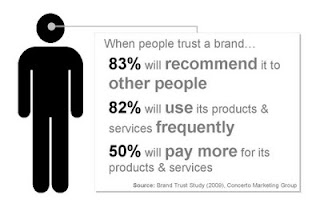
How Tapping into Emotions Plays a Larger Role in Building Brand Trust

Monday, October 24, 2011
5 Key Elements of Social Media Success
Each month, people spend the equivalent of 1.3 million years on Facebook. That’s a lot.
But it’s no wonder: we spend a lot of time on Facebook and other social media because we can do a lot – stay in touch with family and friends, stay up-to-date on news and, for many businesses, stay in front of customers and prospects.
For B2B marketers, however, there are still many questions about what to do with social media and how to do it. Fortunately, answering many of these questions – on best practices, strategies, etc. – was the mission of the recent PR + Social Media Summit (#PRSMS) I attended at Marquette University.
The all-day summit featured 15 sessions jam-packed with valuable information, but here are five of the most interesting takeaways:
1. Content remains key. You need to share valuable content with an honest, transparent voice in order to build an active community that fuels conversation and growth. Make it fun, honest, relevant and valuable. Look for stories that are happening within your organization – stories that your audience can’t find anywhere else – and tell them in a unique way.
2. Social = listening. As much as you need good content, you should still listen more than you talk, answer more than you promote, and above all else, provide value. Listen to answer this question: What does my audience need, and how can I help?
3. Not everything happens online. Develop offline elements to your social programs. Get your teams out in the field to interact with your audiences.
4. Think long term. The greatest value of social media is the ongoing relationship, not the initial interaction.
5. Represent the whole organization. To be effective, social media has to be integrated across all functions to effectively communicate your key messages and address customers’ questions or concerns instantly.
What ingredients do you think are necessary for a recipe of social media success? Ultimately, social media engagement is about proving your value, so audiences will share positive interactions with their networks, encouraging others to turn to you for similar business solutions.
For further reading, you can review some of the summit speakers’ presentations at http://www.slideshare.net/prsmsummit.
Thursday, September 22, 2011
Don’t Just Earn Media. Earn Attention.
The good news is that you can connect directly with them in these realms. But that doesn’t mean they’ll pay attention – too many choices, too little time. That’s why building brands is no longer just about earned media, but about “earned attention.”

- Share content and commentary about industry trends and best practices.
- Highlight what your business offers in the context of these conversations.
- Provide thoughtful updates, such as customer successes, that include a call to action.
- Show your lighter side, which helps to strengthen connections and build loyalty.
What do you think are challenges faced by B2B marketers seeking earned attention, and what advice would you have to achieve this important new objective?
Friday, July 29, 2011
Facebook Makes It Easier to Build Your Page (But You Still Need a Strategy)
Score one for Facebook in its ongoing battle with Google, with the latest round focused on bringing businesses into the social networking fold.
This week, Zuckerberg et al. unveiled a tidy new how-to guide for businesses to create their own pages. Meanwhile, Google remains wishy-washy on how to integrate businesses into its new Google + network.
At first glance, Facebook for Business appears to be a helpful, straightforward resource (CNET’s take here). However, the site mostly covers the mechanics of setting up your page and maximizing its functionality.
To gain the biggest advantage with your Facebook presence, you still need clear objectives and a solid strategy to match.
So as you try out Facebook’s new guide, why not refer back to these key considerations for your company Facebook page.
Friday, July 8, 2011
Quick Response, Quick Death? Critics Question QR Codes’ Effectiveness
How many people, when they see a QR code, know what it is?
How many of them have a smartphone capable of doing anything with that little pixelated box?
How many of them have already downloaded the correct application for reading the code?
And when they take the time to have their phones read the code, where does it take them?
QR codes are an increasingly popular marketing tactic. But critics such as these columnists in Business Insider and AdAge are raising questions about whether all the fuss is really futility.
It’s healthy to have a sense of skepticism about the latest tech fad. And QR codes, which may prove to be transitional rather than transformative technology, fall into that category.
But we shouldn’t immediately dismiss them. QR codes, despite their shortcomings, offer a low-cost chance to engage customers and prospects in new ways. Just don’t let yourself believe that they’re some kind of magic potion.
Start with a smart strategy, incorporate a compelling offer, put it in a place where your target audience is most likely to use it … and a QR code might just bring a little something extra to your next campaign.
Thursday, May 5, 2011
Are You Winning the Intensifying Tug-of-War for Talent?
At a time when “unemployment remains stubbornly high,” you might think that recruiting talent doesn't need to be a priority.
But you might be wrong.
As economic acceleration continues, your competitors—some big, some small—are becoming more active and savvy in recruiting. They’re finding new ways to reach the talent of tomorrow that will help keep their companies innovating, evolving and growing in changing times.
Successful recruiting today means:
- Connecting with candidates where they are—mobile platforms, social networks, etc.
- Making it part of everybody’s job, through continuous internal communications that show everyone why a robust talent pipeline matters to the future of your company.
- Building a culture and brand that people want to be a part of.
In other words, it’s a lot more than just an open-positions web page or the occasional jobs-fair appearance.
So let’s hear it in the comments: What are you doing differently today to help attract the talent you need to succeed?
Friday, March 18, 2011
3 Reasons not to Abandon In-Person for Online
Don’t get us wrong: You definitely should be taking advantage of social media and other online channels to reach target customers cost effectively.
But an article in the latest issue of B2B Magazine is a good reminder of the importance of the flip side to these virtual interactions—real-life, face-to-face meetings.
Despite the considerable cost advantages of digital, every marketer needs to understand the value of balancing online and in the flesh. Whether at a tradeshow, a focus group or a lunch meeting, here are just a few reasons why in person is still in vogue:
· Clear communication. Tone and context can sometimes be lost in virtual interaction. People understand so much better when you can look 'em in the eye.
· Candid insights. Sitting down with customers (or potential customers) will yield more candid responses—especially beneficial when conducting research or building relationships.
· Undivided attention. People are far more likely to multitask in virtual encounters. Meeting them face to face demands their attention, increasing openness and recall.
There’s probably no better day than Friday to catch a potential customer in a good mood, so go ahead and set something up today.
Wednesday, October 6, 2010
Adding a Little Clarity to Shankman’s Animated Message
Peter Shankman talked a lot.
Peter Shankman talked fast.
And in a talk titled “First, SHUT UP,” Peter Shankman didn’t take his own advice.
Ah, but we kid because we care—after all, we still came away with plenty of worthy tips last week when the founder of Help a Reporter Out spoke at PRSA Southeastern Wisconsin’s monthly meeting.
The theme of his hyperactive, hour-plus presentation was “new rules for communication in an era of social media.” In the interest of rule #2 (brevity), we’ll let you read a synopsis somewhere else.
Instead, I’d like to zero in on just one big point Shankman made: the importance of good writing.
What is good writing today, however? The Internet continues to advance more informal, conversational communication—the kind of writing that horrifies traditionalists and even, to some extent, a well-known social media thought leader such as Shankman.
As a pet peeve, he cited the spread of text-friendly shorthand into realms where it’s neither necessary nor appropriate, such as an interview thank you note.
But I’m not here to slam your Us and 2s. As stated above, I’m all for brevity, and shorthand often does the trick.
What I’m more concerned about is clarity.
In the Internet Age, it seems we’re sacrificing being clear for being quick. From email to blog posts to text messages to facebook updates, we’re all writing more often … while making less sense.
Fortunately for you and me, that means there’s an opportunity to stand out with a simple, focused message. So whatever you’re writing, stop to ask yourself if your point is clear. Better yet, ask somebody else to read your writing and assess it based on the same criterion.
And if my point isn’t clear here, feel free to call me on it. At which point, unlike Peter Shankman, I’ll just shut up.
Friday, September 10, 2010
2 September Events You Won’t Want to Miss
Here’s a pair of great upcoming opportunities for business inspiration and marketing insight.
The MMAC Future 50 Awards Luncheon—Registration Deadline Sept. 10
n Event next Thursday, Sept. 16 at The Pfister Hotel
The Future 50 Program showcases companies that are leading the way to growth in the Greater Milwaukee region. It’s a great way to discover what up-and-coming companies are doing to break through—and how you might learn from their success.
By the way, I’ll be participating in the luncheon panel discussion. No hecklers, please.
PRSA-WI Welcomes Peter Shankman—renowned social media/PR thinker
n Monthly meeting Thursday, Sept. 30, at the Hilton Milwaukee
Peter is perhaps best known for founding Help A Reporter Out, which quickly has become the de-facto standard for thousands of journalists looking for sources on deadline. He is recognized globally for radically new ways of thinking about social media, PR, marketing, advertising, creativity and customer service.
Peter’s presentation, “First, SHUT UP. The New Rules of Communication in an Era of Social Media,” figures to be fascinating and fun. This will be his first visit to
Tuesday, March 16, 2010
Time for a Little Social Media Sobriety
Social media is fascinating. It’s an exciting, fast-evolving realm.
This should be obvious. But with all the hype out there surrounding Foursquare, Google Buzz or whatever the latest, hippest platform is, I guess it’s understandable that expectations become a little inflated.
That’s why it’s good to see some sobriety injected into the social media discussion, like this Wall Street Journal piece interviewing skeptical entrepreneurs.
The article cites a study of 500 owners of small businesses, only 22 percent of whom reported making a profit from their social media initiatives last year.
That stat handily exposes one big drawback of social media spending: that it’s still sometimes difficult to tie what you’re doing directly to definitive ROI.
But expecting social media engagement to suddenly, dramatically boost profits is asking too much. Better to think of social media as a great new opportunity to connect with target audiences.
Curb the irrational exuberance a bit, and you may find that a social media program is a cost-effective way to understand your customers and serve them better than ever.
Friday, February 26, 2010
Social Media Buzz Begets Higher TV Ratings?
On the heels of last week’s post reminding us that social media hasn’t killed email marketing, turns out the social media hordes haven’t devoured TV, either.
The twitterati may even be boosting TV ratings, from the Grammys to the Super Bowl and now the Olympics.
It’s just a theory at this point, but it makes sense from a “rising tide lifts all boats” perspective. Or maybe from a “no such thing as bad publicity” mindset?
The point is that all media are increasingly interconnected, so a win in one channel can easily be leveraged for a win in another. Just keep that snowball rolling along the same strategic path, and watch it grow bigger and bigger.
Friday, February 19, 2010
Email marketing lives!
Well, whaddya know: social media isn’t killing email, according to a new survey.
Actually, it seems, people who are active in social media check their email more often.
That’s not entirely surprising when you think about it. People who are active in one online realm are likely to be active in another. Plus, notifications about social media goings-on come through personal email—another reason to check your inbox regularly.
So, what’s it mean for marketers? Greater bang for the buck, basically.
Because social media and email and blogs are all interconnected, and increasingly so, the opportunities are more bountiful than ever to share your message and expand your reach. A morsel of good news coverage can become an upbeat tweet, an article in your email newsletter, and so on.
It’s yet another reason why a cohesive online strategy is essential. Figure out what you’re trying to accomplish and whom you’re trying to reach, and take advantage of every way possible on the web to do so.
Friday, January 15, 2010
Txt to ‘Haiti’ to 90999: In Tragedy, a Fundraising Triumph
By now, you’ve probably heard that you can quickly, easily donate $10 to
Without the text-to-donate opportunity—and the phenomenal publicity it’s received via social media, blogs and traditional media—would the relief effort be so flush with funding, so immediately? Not likely. Text donors account for at least one-fifth of the Red Cross’ earthquake relief fundraising so far.
It’s a breakthrough—a timely, convenient, impactful way to participate and help people in such dire need. And, as MediaPost points out, the $10 texting effort has reached a younger generation of donors who might not otherwise take the time or feel like they have the money to contribute.
For so many nonprofit organizations, at a time when money is tight and the need to find new people to support and sustain their missions is greater than ever, the rise in mobile marketing represents an excellent opportunity to engage with younger audiences.
For example, mPower, a Milwaukee-based under-21 drug and alcohol crisis hotline, is reaching its target audience with a combination of text messaging, social media and traditional channels. A campaign encouraging teens to text mPower and sign up for mobile alerts—for a chance to win a Nintendo Wii—has been a great success.
It’s good to see charitable organizations putting these new technologies to effective use, and the
Oh, and if you haven’t already done so, please consider taking a moment to give to the relief effort. If texting isn’t your thing, here are some other ways to donate.
Friday, November 13, 2009
Key Considerations for Your Company Facebook Page
Should your business be on facebook?
Yes. With more than 300 million users across all demographics, you shouldn’t ignore this channel.
However, what you do with your facebook page is a different matter. Many companies may be unsure how to proceed in this huge but still evolving arena.
Maybe start by consulting this helpful primer on facebook pages for small businesses in The New York Times (sign-in required). There are some good links to other resources there, so by all means, read the article when you have time (away from facebook).
In the meantime, some key takeaways:
- Start with strategy. Yes, you should be on facebook. No, you should not be aimlessly wasting time. However, there’s a learning curve involved. So identify objectives, and start experimenting now with ways to achieve them.
- Show, don’t sell. People use facebook to interact, not to buy things. They’re interested in the personality of your business, so give them that experience on your page—not a bunch of pushy hype.
- Stay up to date. Regular doses of current and relevant news, events and commentary keep visitors returning.
- Don’t expect too much. Since facebook is about relationships, and relationships take time to develop, maintaining a great page won’t do your salespeople’s job for them.
Friday, November 6, 2009
The Recovery Is Ramping Up. What about Your Marketing?
Feeling a little more optimistic lately?
If so, it’s not without cause. Numerous signs suggest that the economy is continuing to emerge from recession:
- Although we’ve topped 10 percent unemployment, new claims for jobless benefits are down.
- Retail sales are picking up.
- Productivity is hitting new highs.
If you have some other tales of the upswing to point out, please join the conversation at Positive Breakthroughs, a LinkedIn group promoting good economic news.
In the meantime, you should be thinking about how you’ll take advantage of new growth opportunities as they arise. After all, there will be no shortage of companies vying for new business in the coming months.
How are you going to set yourself and your company apart from the fray?
It doesn’t have to mean big spending. As AdAge points out, positioning yourself as a thought leader is a smart, cost-effective way to differentiate yourself and increase your visibility. Whatever niche you’re in, now is the time to demonstrate your expertise through relevant social networks, in the trade publications and on the blogs.
You can start by commenting right here. ;)
Friday, October 30, 2009
New CNN Site Did Your Web Design Homework
Not sure if it’s as “beautiful” and “visually arresting” as the CNN folks claim, but it definitely has a greater emphasis on images, video and easily digestible, modular content. Adweek says there’s a lot more interactive, social functionality, as well.
The redesign reflects an important step in CNN’s transition—from just an online iteration of a TV network, toward a distinct news site that takes advantage of the web’s unique capabilities. But good as the new site is, it isn’t by any stretch revolutionary. CNN’s really just following the lead of non-mainstream news sites such as The Daily Beast and Newser.
The difference? CNN is a big organization backed by an even larger corporate parent, Time Warner. The changes they’ve made are almost certainly driven and justified by thorough research. They’ve looked carefully at what the audience wants: a more custom user experience and greater involvement with the content. These results appear to validate the savvy design and social aspects of those alternative news sites.
That’s why it’s a good idea for all of us to pay attention. The new CNN shows that social functionality, quick-read convenience and interactive communication are now mainstream must-haves on the web.
OK, so your site won’t make Alexa’s top 500 anytime soon, but you can still benefit by deploying some of the best practices of those that do.
Friday, October 2, 2009
An Old-School Social Media Success
But just as often, success in social media is simply about finding more efficient, effective ways to solve problems and increase customer satisfaction.
Take this Pitney Bowes example we just read about.
The postage meter people decided that maybe they were spending too much time and money on customer support phone calls. So they created an online user forum where customers could pose and answer each other’s questions, moderated by the company.
With the help of customers’ diverse content input—kind of a crowdsourced FAQ—Pitney Bowes’ forum quickly delivered robust answers to many of the most common questions that people used to call the hotline for. In the process, they’re saving the company money and customers lots of stressful time on the phone.
And maybe the most important (and reassuring) lesson here is that they did it without using the latest and greatest platforms. No Twitter, no Facebook, no StumbleUpon—just a clear objective and good ol’ forum, with great results.
Friday, August 14, 2009
Lessons from a ‘Best Buy’ That Wasn’t
Instead, we get what amounted, more or less, to a classic “no comment.” In fairness to Best Buy, the retailer is refunding everyone who ordered the sets at that eye-popping price on bestbuy.com. And the official word from the company was oops, sorry for the misunderstanding.
But that was followed by a gentle reassertion of the company’s right to change pricing and availability of products at any time. And beyond that, Best Buy is mum.
Why? Seems to us like the perfect opportunity to turn a mix-up into a make-up with customers. Turning an unhappy customer into a satisfied one is one of the quickest routes to positive word of mouth (and great PR). For Best Buy, it could have been as simple as sending all the aggrieved a little Best Buy gift card (or at least a decent coupon) along with their refund. Then, of course, announce loudly that you’re doing that.
Alas, that’s not happening. Meanwhile, customers are griping, news outlets are spreading the story and Best Buy is looking kind of cold and careless.
Thursday, August 6, 2009
Branding is back, baby!
It’s understandable, but it’s also ill-advised. Why? Because in a shrinking market, you have to aggressively protect and grow your share. And you can’t do that by focusing on your products and services alone. Doing so only plays into the trap of commoditization.
We think it’s time to give brand building a little love again. Good thing we have this powerful tool nowadays that can help you build your brand directly and cost-effectively with customers. Maybe you’ve heard of it. It’s called social media.
Check out this decent primer in The New York Times on managing your reputation online (or, in other words, building brand equity).
Opportunities abound to connect with customers, solve their problems, anticipate new ones and cultivate trust every step of the way—exactly the vibe customers are seeking in these uncertain times. Social media is an excellent path to reinforce your brand and build the confidence your customers need to have for you to win their business. Yes, branding is back, baby! It’s online, it’s every day, and it’s here to stay.
Friday, July 24, 2009
As Social Media’s Status Rises, Don’t Ignore the ‘Why’
Indeed, we’re all atwitter about the interactive, community-building possibilities. And as we’ve said before here, here and here, you should be experimenting in social media.
But at the same time, a word of caution. We’re talking about experimenting here. And experiments sometimes fail. As marketers, we can’t let ourselves get so tangled up in social media excitement that we don’t recognize when our efforts aren’t achieving any marketing objectives.
For example, as one BtoB commenter points out, it’s nice that we marketers are flocking to social media, but we should also consider whether our target audience in any given case is active in these emerging channels. If not, why waste the time?
So while we’re listening and chiming in online, we also should be thinking about how social media dialogs fit with our goals and strategy. Shooting for a quota of sales leads? Just trying to stay on top of what customers care about? We can’t expect too much from our Tweets, replies, status updates, etc. But we should expect something.
In social media, at a minimum, we need some idea what we’re getting into—and what we’re trying to get out of it.